Brands ask us the same question at least once a week: "What does a TV commercial actually cost?" The honest answer is: it depends — but in a more specific and useful way than that phrase usually implies. A 30-second spot can be produced for €40,000 or for €2,000,000, and both can be the right answer depending on what you are trying to achieve, which market you are broadcasting in, and how the spot fits into a broader campaign architecture. This guide walks through the complete production process, what each phase actually costs, and what separates commercially effective TV spots from expensive footage.
Why TV Production Still Matters
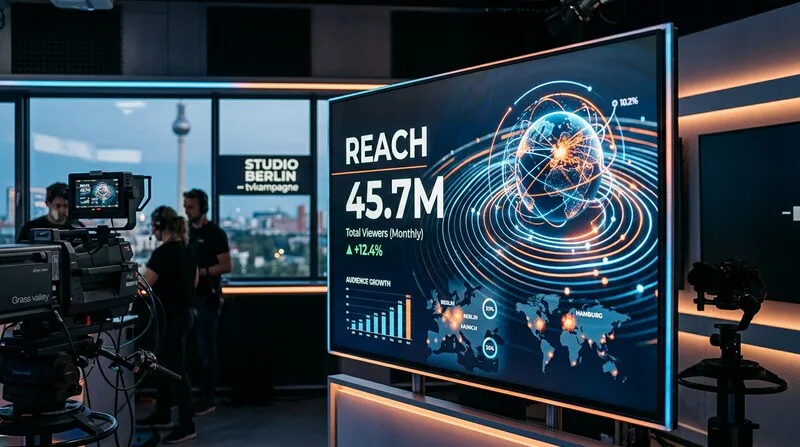
Linear TV audiences are declining in almost every market. Yet TV advertising spend continues to be justified by brands that understand what the medium actually delivers: mass simultaneous reach, brand credibility through production quality, and the emotional power of combining image, sound, motion, and story in a format that commands full-screen attention. A TV spot that runs in primetime on a major broadcaster reaches millions of people simultaneously — an audience scale that no digital channel replicates.
More importantly, TV production quality sets a credibility signal. A professionally produced 30-second spot tells viewers: this brand is real, established, and invested in quality. This signal is increasingly valuable as digital advertising becomes associated with low-trust, intrusive formats. Brands that maintain a TV presence — even at modest frequency — report meaningfully higher brand trust scores than comparable brands present only in digital channels.
And in 2026, TV production assets do not stay on TV. The same spot, recut to 6, 15, 20, and 90-second variants, runs across YouTube, CTV, social video, and cinema. The production investment amortises across every screen where video advertising runs — making the cost-per-exposure calculation significantly more favourable than TV-only analysis suggests.
The Production Process
Professional TV commercial production moves through five sequential phases: brief and creative development, pre-production, production shoot, post-production, and distribution and broadcast mastering. Each phase involves distinct teams, decisions, and cost drivers. Understanding the structure prevents the most common client mistakes: underestimating timelines, approving scripts without visualising their production implications, and underinvesting in post-production where much of the spot's final impact is determined.
The Creative Brief
The brief is the foundation of every production. A weak brief produces expensive revisions, misaligned creative, and costly reshoots. A strong brief answers six questions with specificity: Who is the target audience (with demographic and psychographic detail, not just age range)? What is the single most important thing the viewer should feel, think, or do after seeing this spot? What is the tone — emotional/inspirational, humorous, informational, aspirational? What are the absolute musts (product features, brand guidelines, legal disclaimers)? What are the absolute avoidance areas? And what does success look like — what metrics will determine whether this spot worked?
The brief is a client responsibility, not an agency responsibility. Agencies can help sharpen and translate a brief into creative direction, but the strategic clarity must come from the brand. The most expensive TV commercials ever made were expensive partly because the brief kept changing after production began.
Pre-Production (The Invisible Work)
Pre-production is the most underestimated phase of TV commercial production. It is where every decision about the shoot is made, and every problem that is not solved here becomes a production day problem — which is 5-10x more expensive to fix on set than at the planning stage.
Pre-production encompasses: creative concept development and script finalisation, director selection and briefing, casting (for on-camera talent and voice-over), location scouting and permitting, prop and wardrobe sourcing, crew assembly (director of photography, gaffer, art director, production designer, hair and makeup, etc.), shoot scheduling and logistics, and final budget reconciliation. For a standard mid-range production, pre-production alone takes 3-5 weeks and involves dozens of individual decisions.
Director selection deserves particular attention. The director is the single most influential variable in a commercial's quality. Different directors have distinct strengths: some excel at performance-led emotional storytelling, others at product cinematography, others at comedy or action. Matching director style to brief requirements is a skill that experienced production companies and agencies have honed over years of production partnerships.
Production Day
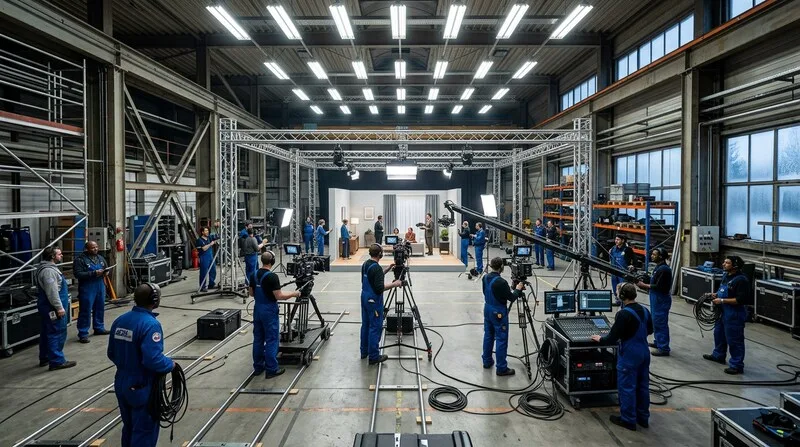
The shoot itself is typically 1-3 days for a 30-second commercial, depending on the number of scenes, locations, talent requirements, and complexity of the concept. A production day for a mid-range commercial involves 30-60 crew members, equipment valued at hundreds of thousands of euros, and a clock that costs €5,000-15,000 per hour when overrun.
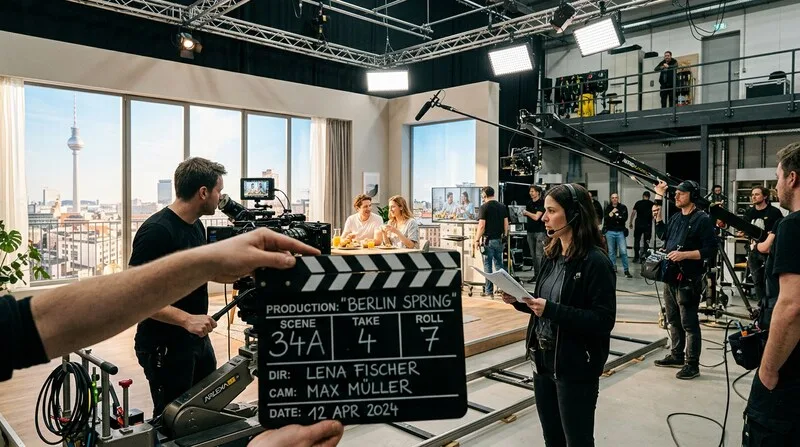
The most important thing clients can do on production day is to have a single decision-maker present. Every creative decision that goes to committee on set costs time, money, and momentum. The second most important thing is to complete all approvals before production begins — script, casting choices, location decisions, tone direction. Changes made on set are ten times more expensive than changes made in pre-production.
Post-Production
Post-production is where the commercial is actually made. The raw footage from a shoot day looks nothing like the finished spot. Post encompasses: offline edit (assembling the rough cut), picture lock (final edit approval), colour grading (establishing the visual tone), music composition or licensing, sound design and mix, visual effects and motion graphics, voice-over recording, legal compliance review, and final broadcast mastering to technical specifications.
For most 30-second spots, post-production takes 3-6 weeks. Compressed timelines are possible but add cost. The colour grading and sound mix are particularly consequential — they transform competent footage into emotionally resonant advertising. Under-investing in post is one of the most common mistakes brands make when compressing budgets: saving €20,000 on post to a spot that cost €200,000 to shoot is rarely a sensible trade-off.
Distribution and Media Buying
Producing the spot is only half the investment. Airing it requires a media buying plan that is separate from and typically larger than the production budget. Linear TV media buying involves purchasing GRP (Gross Rating Points) — a measure of reach times frequency within a target demographic. A national primetime campaign in Germany, France, or the UK costs €100,000-1,000,000+ per week of airtime for meaningful reach.
The spot also needs to be delivered in broadcast-compliant formats to each broadcaster — a technical process involving loudness normalisation (EBU R128), colour space compliance, and format packaging (AS-11, MXF) that requires specialist finishing. This "last mile" of technical delivery is frequently overlooked in production budgets and can add €2,000-8,000 per market.
Cost Breakdown
| Production Level | Total Budget | What You Get |
|---|---|---|
| Low-budget | €30,000–80,000 | 1 shoot day, small crew, local locations, basic talent, standard post |
| Mid-range | €100,000–300,000 | 1-2 shoot days, professional crew, quality casting, commissioned music, full post |
| Premium | €400,000–800,000 | Named director, international locations, celebrity talent, VFX, multiple edits and formats |
| Flagship | €1,000,000+ | Award-level director, full VFX, multi-country shoot, A-list talent, broadcast + digital suite |
The Streaming Shift
The most significant structural change in TV commercial production is the rise of CTV (Connected TV) and streaming advertising. Platforms like Netflix, Amazon Prime Video, Disney+, and Hulu's ad-supported tiers now reach audiences that have largely abandoned linear TV — and they accept the same broadcast-quality video assets. A spot produced for linear TV now runs across CTV with no additional production cost, accessing a younger, more affluent, and more engaged audience than linear TV delivers in most markets.

This shift also changes creative requirements: CTV ads are often skippable after 5-15 seconds, placing higher demands on the opening frames than traditional broadcast, where the ad cannot be skipped. Spots designed for CTV need to establish brand and hook within the first 5 seconds, which requires a different opening structure than traditional 30-second spots designed for captive broadcast audiences.
Frequently Asked Questions: TV Commercial Production
How much does a TV commercial cost?
TV commercial production costs vary significantly by production level. A low-budget spot (€30,000–80,000) covers a basic concept, one shoot day, standard post-production, and a small cast. Mid-range production (€100,000–300,000) enables a proper creative concept, 1-2 shoot days with professional crew, quality talent, and full post-production. Premium productions (€400,000–1,000,000+) involve award-level directors, multiple shoot days and locations, international talent, and high-end VFX. These are production costs only — media buying (the cost of airing the spot) is a separate and typically much larger budget.
How long does TV commercial production take?
A standard TV commercial takes 8-16 weeks from creative brief to broadcast-ready deliverable. Breakdown: creative development and concept approval (2-4 weeks), pre-production including casting, location scouting, and crew booking (3-5 weeks), production shoot (1-3 days), post-production including editing, colour grading, sound design, and VFX (3-6 weeks), and final approvals and broadcast mastering (1-2 weeks). Rushes are possible in 4-6 weeks for simpler productions but cost significantly more due to overtime and compressed creative iteration time.
Should I use a film production company or advertising agency?
Typically both — with different roles. Advertising agencies develop the creative strategy, concept, and script, then engage a specialist production company (through a competitive pitch process) to execute the shoot. Production companies have the technical infrastructure, director relationships, and crew networks. Agencies have the brand and strategic knowledge. For smaller budgets, integrated agencies that handle both creative development and production offer cost efficiency. For high-budget flagship campaigns, the two-partner model delivers the best results as each party stays in its area of expertise.