While the marketing world debates algorithms and CPMs, some of the most effective advertising messages simply roll through the city. Vehicle wraps and outdoor advertising are the oldest forms of advertising -- and they still work.
Vehicle Advertising: Your Fleet as a Medium
A wrapped vehicle generates between 30,000 and 70,000 impressions per day according to the Outdoor Advertising Association of America (OAAA) -- in a major city even more. And with no ongoing costs after the one-time investment.
Costs and Reach
| Format | Cost | Notes |
|---|---|---|
| Full Wrap (Car) | 2,000–4,000 EUR | One-time cost, no ongoing media fees |
| Partial Wrap (Sides) | 800–1,500 EUR | Good entry point for budget-conscious brands |
| Full Wrap (Van) | 3,000–6,000 EUR | Maximum visibility, ideal for trades/delivery |
| Durability | 3–5 years | With premium film — lifetime CPM among the lowest of all ad formats |
| Calculated CPM | <0.10 EUR | 30,000–70,000 daily impressions in urban areas |
DOOH: Digital Out-of-Home
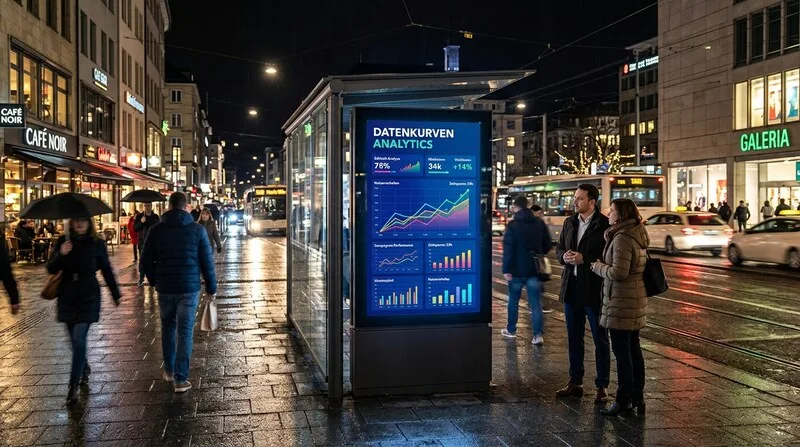
Digital outdoor advertising (DOOH) is the growth star of the industry. LED screens in train stations, shopping centers, and on building facades show dynamic, often interactive advertising. According to JCDecaux, DOOH grows 10-15 percent annually.

Guerrilla Marketing: Creative Over Expensive
Legendary Guerrilla Campaigns
- Spotify Wrapped Billboards: Every December, Spotify turns user data into witty poster motifs -- personal, funny, and shared millions of times.
- Apple "Shot on iPhone": User photographs on massive billboards. Free content production and a statement.
- IKEA "Bookbook": A product video in Apple style for the IKEA catalog. Millions of views and a viral hit.
Classic Billboard Advertising
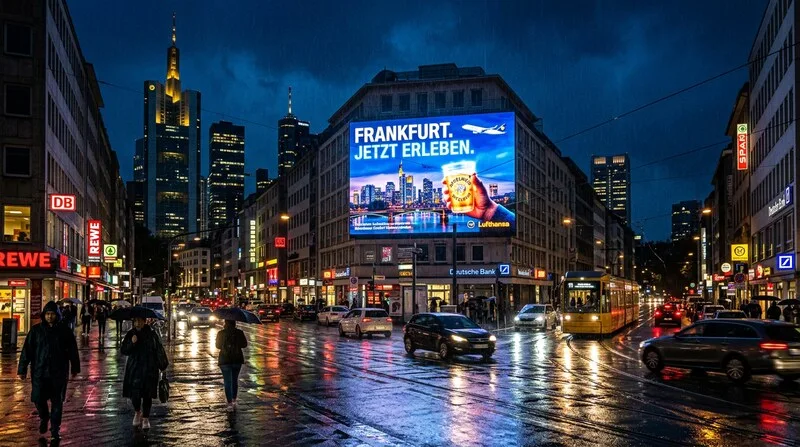
Large-format billboards remain effective -- especially combined with digital campaigns. A billboard at a major train station reaches 100,000+ people daily. The strength: you can't skip, block, or mute them.
The Future of Outdoor Advertising
- Interactive screens: Passersby interact via gesture or smartphone
- Augmented Reality: AR layers over physical posters via smartphone camera
- Programmatic DOOH: Automated outdoor ad buying like Google Ads
Vehicle Wrap Design: What Actually Works
A poorly designed vehicle wrap is worse than no wrap at all. A cluttered, illegible design driving through a city communicates noise, not brand. The principles for high-performing vehicle wrap design:
- Maximum contrast: Dark text on light background or light on dark. Mid-tone backgrounds with same-tone text are invisible at speed.
- Three-second rule: At 50 km/h, a passerby has approximately three seconds to register your message. Lead with one element: either the logo, a single headline, or a phone number -- not all three.
- Large logo, minimal text: The brand mark should be readable from 20 meters. A tagline is optional. A website URL is secondary. A phone number only if the business model depends on direct calls.
- White space is not wasted: The most effective vehicle wraps use significant negative space. Blank surface makes the logo look confident. A fully covered surface looks desperate.
- Night legibility: Reflective vinyl elements and illuminated components (for buses and trucks) extend reach into evening hours. Fleet operators often underestimate night-time impression volume.
The test: design the wrap, then ask someone who has never seen it to describe what they learned from a 3-second viewing. If they can name the brand and one key message, it works.
Planning Your OOH Campaign: A Practical Checklist
Whether you are running vehicle wraps, DOOH, billboards, or guerrilla marketing, successful outdoor campaigns follow the same planning logic:
- Define the geographic objective: Are you building city-wide awareness, targeting a specific district, or conquesting a competitor's location? Geographic precision reduces waste and increases relevance.
- Match format to audience movement: Commuters encounter billboards at major intersections. Shoppers see city lights in pedestrian zones. Business travelers see airport advertising. Match format to the moment.
- Plan content production separately: Outdoor creative requires different resolution, aspect ratios, and text sizes than digital or print. Brief outdoor creative as its own workstream.
- Book at least 4 weeks in advance: Premium OOH placements -- major train stations, digital screens in high-traffic areas -- are sold out weeks ahead. Programmatic DOOH enables faster placement but with less prime-location guarantee.
- Integrate with digital: Run parallel digital campaigns targeting the same geographic areas as your OOH. Digital amplifies outdoor awareness; outdoor builds brand trust that improves digital CTR. Read our Cross-Channel Campaign guide for the full integration framework.
The brands that win at outdoor advertising treat it as a channel in a system, not a standalone tactic. A billboard a consumer sees in the morning and then re-encounters as a digital ad in the afternoon generates 2-3x the brand recall of either format alone.
Conclusion: Be Visible Where Life Happens
Outdoor advertising reaches people where they move: on the street, in the car, at the station. In a world where digital advertising is increasingly filtered and blocked, outdoor advertising has an invaluable advantage: it is impossible to overlook.

Frequently Asked Questions: Vehicle Wraps and Outdoor Advertising
How much does a vehicle wrap cost?
Vehicle wrap costs in Germany: Full car wrap (design + print + installation): €1,500–4,000 for a standard vehicle. Full van wrap: €2,500–6,000. Fleet wrap (10+ vehicles, bulk pricing): €1,000–3,000 per vehicle. Partial wrap (hood, roof, or side panel only): €500–1,500. Magnetic decals (removable, lower commitment): €100–400. Premium materials (longer-lasting films, more complex designs) cost more. Lifetime of a quality wrap: 5–7 years, which makes it among the most cost-efficient forms of ongoing advertising — a €3,000 wrap generating 30,000 daily impressions works out to fractions of a cent per impression over its lifetime.
Is outdoor advertising still effective in 2026?
Outdoor advertising (OOH — out of home) has proven remarkably resilient despite digital's rise. In Germany, OOH spending grew 8% in 2024 as brands recognized its unique advantages: it cannot be skipped, blocked, or scrolled past; it reaches people when they are physically mobile and receptive; and it provides geographic targeting that pure digital lacks. Digital OOH (DOOH) has reinvigorated the format — programmatic digital billboards now allow daypart targeting, weather-triggered messaging, and creative rotation. For local businesses especially, vehicle wraps and local billboard advertising deliver exceptional local brand awareness at costs far below regional TV or radio.
What are the best outdoor advertising formats for local businesses?
Top OOH formats for local businesses: Vehicle wraps (your own fleet or rented space) offer the best cost-per-impression for route-based businesses (delivery, trades, service). City light posters (1/1 poster, 9.4 m²) cost €250–600/week per panel and appear at high-pedestrian locations. Shopping center advertising (lightboxes, floor graphics) reaches buyers at the moment of purchase consideration. Local bus advertising (full or partial wraps) reaches commuters repeatedly on fixed routes. Digital screens in retail environments (petrol stations, pharmacies, gyms) deliver targeted messages at point-of-relevance. The most underused format: window graphics on your own retail premises, which are free to implement and generate significant foot-traffic impact.